How Does Incense Bead Bracelet Wholesale Work for MOQ, Packaging, and Lead Time?
By Yiling Cultural Partners
Incense bead bracelet wholesale terms depend on the selected bracelet, quantity per design, packaging, customization, and destination. MOQ means minimum order quantity; it may apply separately to bracelets and printed packaging. Confirm when production lead time starts and whether it ends at dispatch or delivery. Yiling Cultural Partners provides private quotations, so exact minimums, prices, and timelines require confirmation for your order.
- Ask for both the total order minimum and the minimum per product variant.
- Confirm packaging minimums separately from bracelet quantities.
- Approve a physical sample and written specification before production.
- Separate production, inspection, transport, and customs time.
- Compare the total cost of the same specification, not just unit prices.

What does an incense bead bracelet wholesale order include?
An incense bead bracelet is an accessory made with aromatic beads. For procurement, distinguish formed blended-incense beads from solid aromatic wood or fragrance-treated beads. The construction affects the information needed about materials, surface finish, scent, and care. Do not assume products with similar names have identical composition.
A wholesale order supplies products for business resale or distribution. Private-label packaging presents them under the buyer’s brand. Neither term automatically includes exclusive designs, custom formulas, testing, printed cards, or individual shipping to retail customers.
Define the order as a complete specification: bracelet, cord, dimensions, packaging, inserts, labels, and shipment preparation. Use the Spiritual Product Guide for wider product context.
How is MOQ calculated for incense bead bracelet wholesale?
MOQ is the smallest quantity a supplier agrees to accept under specified terms. A SKU, or stock keeping unit, identifies a product variant. Different bead sizes, blends, bracelet sizes, or packaging versions may be treated as separate SKUs.
Commercial recommendation: request a written minimum for each relevant layer. A total order quantity does not tell you how many designs can be mixed, and a bracelet minimum does not establish a printed-box minimum.
| MOQ layer | What it controls | Question to ask |
|---|---|---|
| Total order | Overall quantity or order value | Is the minimum based on units, value, or both? |
| Per SKU | Quantity of each variant | Can sizes and blends be mixed? |
| Custom production | A new blend, size, component, or finish | Does this change require a separate batch? |
| Printed packaging | Boxes, sleeves, labels, or inserts | Does each artwork or language version have a minimum? |
| Repeat orders | Replenishment under an existing specification | Are reorder minimums different, and under what conditions? |
If packaging must be purchased in a larger quantity than bracelets, agree who owns the unused packaging, where it is stored, any storage charges, and what happens after an artwork change. Do not treat unconfirmed future reorders as a reason to buy excess inventory.
Which order option should a buyer compare first?
Ask suppliers to quote feasible options against the same product brief. The comparison below describes purchasing approaches, not confirmed Yiling packages or guaranteed differences in price and speed.
| Approach | Potential use | Confirm before ordering |
|---|---|---|
| Existing bracelet, standard packaging | Testing a product range | Actual stock, available variants, and pack condition |
| Existing bracelet, branded insert or sleeve | Adding a brand story | Print minimums, artwork approval, and assembly fees |
| Custom bracelet and packaging | Developing a defined collection | Sampling, material availability, production minimums, and schedule |
| Multi-item gift set | Campaign or gifting programs | Component availability, fit, packing sequence, and carton size |
For an initial order, reducing the number of variants can make sample approval and replenishment easier to manage. This is a planning recommendation, not a promise of lower supplier minimums. The wholesale guide for crystal shops and gift stores covers broader assortment decisions.
What packaging should a wholesale buyer specify?
Separate the presentation pack seen by the customer from the protective shipping pack. A pouch or gift box may suit the brand, but the complete packed bracelet must also withstand its intended handling and transport.
- Product protection: specify how the bracelet is held, separated, and protected from rubbing or loose movement.
- Material compatibility: assess contact with liners, printing, adhesives, and other scented items using the actual product.
- Retail presentation: approve dimensions, colors, logo position, closure, and card placement.
- Shipment configuration: confirm units per inner pack and carton, carton dimensions, gross weight, and identification labels.
Do not automatically prescribe airtight bags, desiccants, or fragrance-refreshing treatments. Ask the supplier to justify storage and protection choices for the formulation. Review samples for powder transfer, staining, odor transfer, and damage after agreed handling and storage conditions.
Verifiable external guidance: the International Safe Transit Association’s test procedures distinguish screening tests from transport simulation tests. If testing is needed, select a suitable procedure with a qualified provider. Testing a different box or product does not establish performance for your complete shipment.
For inserts, separate material and care information from symbolism. The guide to product meaning cards without misleading claims supports that distinction.

How should buyers calculate lead time?
Lead time is the elapsed time between a defined starting event and a defined completion event. Ask whether the quoted period begins after payment, sample approval, artwork approval, or confirmation that materials are available. Confirm whether days mean working days or calendar days.
A production estimate ending when goods are ready for collection is not a delivery estimate. Record production completion, dispatch, and expected arrival as separate milestones.
- Sampling and approval: allow for sample preparation, transport, review, and revisions.
- Materials and packaging: confirm availability and print production after artwork approval.
- Bracelet production: include the agreed making, drying where applicable, finishing, and assembly stages.
- Inspection and packing: allow time for checks and any correction before release.
- Transport and receipt: account for carrier transit, customs processing, local delivery, and receiving inspection.
Some tasks can run in parallel. Ask for a schedule showing dependencies rather than simply adding every stage. Work backward from the required warehouse receipt date and agree contingency time with the supplier and logistics provider.
The International Trade Administration’s shipping guidance explains that Incoterms allocate shipping-related responsibilities and costs. Specify the agreed rule, named place, and version; also state the delivery schedule separately. A shipping term alone is not an arrival guarantee.

How does the order process work?
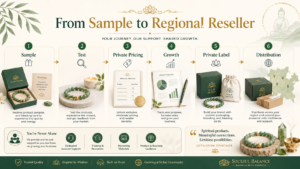
- Submit a brief. Identify the product, quantities by variant, destination, packaging, and required receipt date.
- Review the quotation. Resolve minimums, exclusions, payment terms, and timing assumptions.
- Approve samples. Confirm the actual bracelet and packaging, including artwork and care wording.
- Authorize production. Sign off specifications, acceptable variation, inspection criteria, and change-control terms.
- Review shipment readiness. Check agreed inspection records, quantities, packing details, and shipping documents.
- Receive and reconcile. Compare the shipment with the approved specification and report discrepancies within the agreed period.
Keep an approved reference sample. Require written approval before substitutions to the blend, fragrance treatment, cord, finish, or packaging. Agree defect remedies and responsibility for replacement freight before payment.
What information makes a quotation useful?
A request for quotation, or RFQ, is a written brief that lets suppliers price a defined requirement. Send the following information together:
- Business type, sales channel, destination country, and delivery postal code.
- Product reference, bead construction, dimensions, bracelet fit, and quantity per variant.
- Standard or custom packaging, artwork availability, insert languages, and labeling needs.
- Required receipt date, sample requirements, and inspection or testing expectations.
- Preferred delivery terms and any optional services to quote separately.
Request itemized product, packaging, setup, sample, inspection, and freight charges. Confirm quote currency, validity, payment schedule, and treatment of duties and taxes. Compare quotations using the same specification and delivery scope.
For planning, divide all applicable order costs by the number of saleable units expected. Keep recoverable taxes and reusable packaging inventory separate in your accounting. A lower bracelet price may be offset by packaging commitments, shipping volume, or additional handling.
Who is this wholesale approach suitable for?
This approach suits spiritual shops, crystal retailers, cultural gift companies, jewelry brands, and distributors that can evaluate samples and manage inventory. It is especially useful when a business needs consistent product descriptions, packaging, and a documented reorder specification.
Retailers considering incense beads should assess whether customers welcome scented accessories and whether staff can explain materials and care. Cultural presentation can support gifting, but sales performance should be tested rather than assumed.
Who might need a different purchasing model?
Wholesale may not suit a seller who needs individual customer dispatch unless that service is explicitly agreed. Highly customized production may also be unsuitable for an immediate launch with no approval window. Fragrance-free retail environments may need a different product category.
If supplier minimums exceed a realistic sales and storage plan, discuss fewer variants or available standard options. Do not accept an excessive quantity solely to secure a lower unit price.
What risks and marketing limits should buyers address?
Verifiable product facts include documented composition, dimensions, quantities, and actual inspection results. Cultural interpretations include meanings attached to gifting or personal reflection. Commercial recommendations include the sample, packaging, and scheduling checks in this guide. Keep these categories distinct in supplier and retail copy.
Confirm relevant destination-market requirements for the actual materials, components, intended users, and packaging. Do not assume a generic certificate covers the ordered bracelet. Avoid unverified claims such as “hypoallergenic,” “waterproof,” or permanent fragrance.
The US FTC’s advertising substantiation policy states that objective advertising claims need a reasonable basis before publication. Do not promise health, wealth, or relationship results. Optional Taoist-inspired blessing services do not establish product safety or verified religious affiliation.
Cultural and spiritual services are offered for personal reflection, cultural appreciation and gifting purposes. They do not guarantee specific financial, medical, legal, relationship or life outcomes.
Ordinary wholesale bracelet sourcing does not require customer birth information. If a separate personalized report is ordered, define necessary data, customer authorization, access controls, retention, and deletion before collection.
What questions should you ask before paying a supplier?
- Which minimum applies to the order, each SKU, and each packaging version?
- What is available now, and what must be produced?
- What exactly is included in the sample and quotation?
- Who owns unused packaging and paid tooling or artwork files?
- What starts the production clock, and what event ends it?
- Which changes require another sample or revised delivery date?
- What inspection criteria and defect remedies apply?
- Who handles freight, customs, duties, and shipment claims?
How can Yiling Cultural Partners support this order?
Yiling Cultural Partners’ spiritual product wholesale service lists incense bead bracelets, sample-based cooperation, packaging support, and product meaning cards. Quotations are confirmed privately according to product, quantity, customization, packaging, and shipping needs.
Use your brief to confirm available samples, branding options, order workflow, and cultural-context copy. Ask about bilingual inserts where required. Exact MOQ, material details, packaging specifications, sample charges, and production or delivery dates remain subject to written confirmation for the selected order.
What else do wholesale buyers ask?
Can I mix different bracelet designs to meet the MOQ?
Only if the supplier agrees. A total order minimum may sit alongside a minimum for each design, size, blend, or packaging version. Ask for a quantity breakdown showing which combinations are accepted and whether mixing changes the price. Confirm whether the same conditions apply to repeat orders. Do not assume that a sample assortment proves a mixed bulk order is available under identical terms.
Can I add branded packaging after approving the bracelet?
Yes, this can be discussed, but it may change the order minimum, cost, and schedule. Packaging needs its own approval for fit, artwork, material, and assembly. A bracelet sample alone does not confirm those details. If a launch date is fixed, ask whether a standard pack with an approved insert is feasible. Obtain a revised quotation and timeline before authorizing any packaging change.
Does the quoted lead time include international delivery?
Not necessarily. Suppliers may quote production time, dispatch time, or an estimated arrival window. Ask for the starting condition and final milestone in writing, together with whether the estimate uses working or calendar days. Freight booking, customs processing, and local delivery may be outside the production estimate. For a campaign, specify the required warehouse receipt date and discuss contingency time rather than relying on an undefined lead-time figure.
Will a repeat order have the same price and lead time?
Not automatically. A repeat order can reuse an approved specification, but material availability, production capacity, packaging stock, freight costs, and order quantity can change. Request a fresh confirmation referencing the previous approved sample and specification version. Ask the supplier to flag substitutions before production. If leftover printed packaging will be used, verify its quantity, condition, and artwork version before treating it as available inventory.
What should you prepare before requesting a quote?
A useful incense bead bracelet wholesale inquiry connects quantities, packaging, and timing in one brief. Define the variants, approve the complete packed product, and compare costs and responsibilities on the same basis.
Share your business type, destination, quantity per design, packaging preferences, and required receipt date so the team can confirm a suitable quotation scope.
Get a Wholesale Quote