What Is an Incense Bead Bracelet and How Is It Made?
By Yiling Cultural Partners
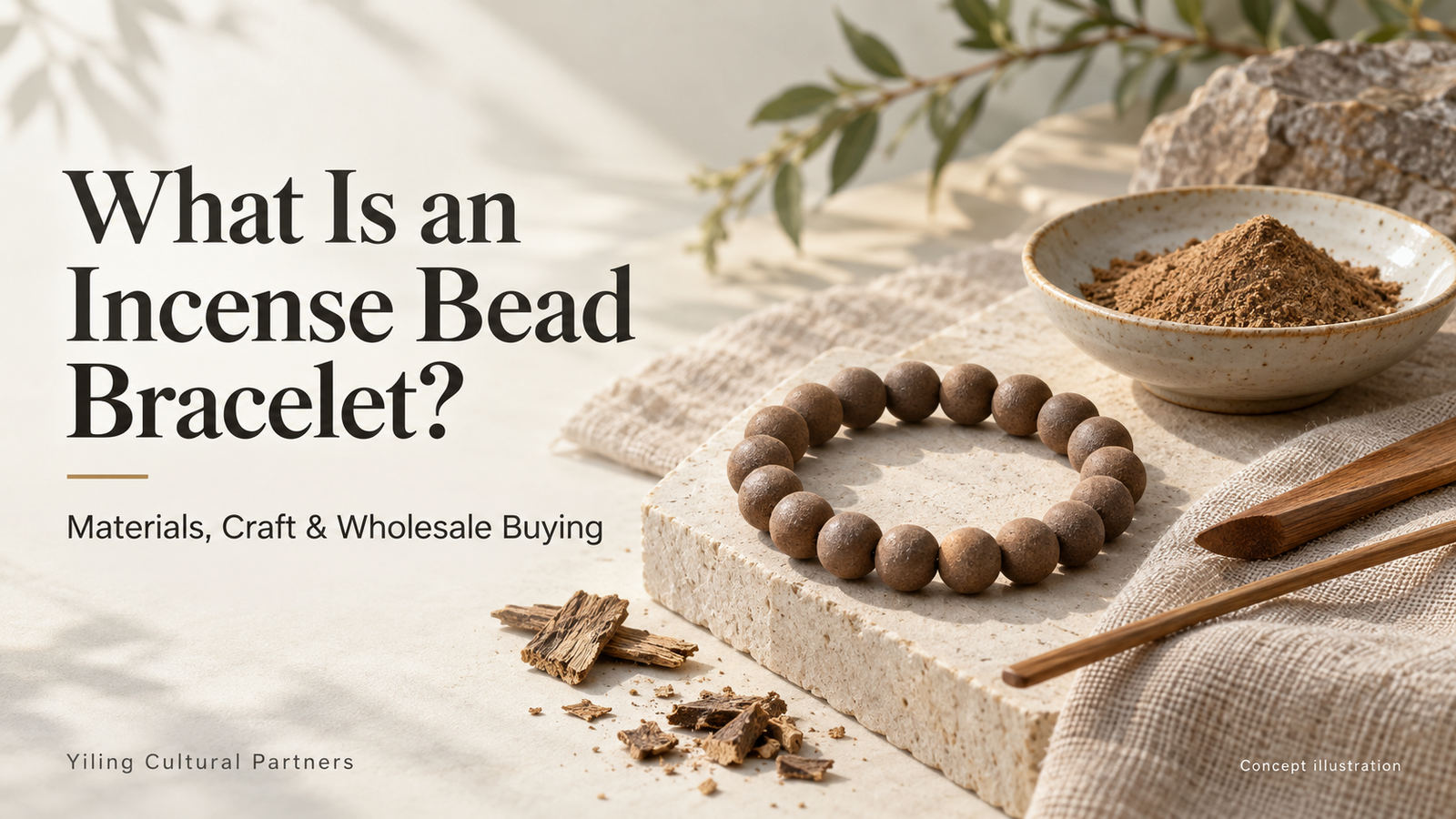
An incense bead bracelet is a wearable accessory made with aromatic beads. In Chinese blended-incense craft, often called hexiang, powdered aromatic materials are mixed with binding ingredients, shaped into beads, dried, finished, and strung. Commercial products vary, so buyers should confirm whether the beads are formed incense blends, solid aromatic wood, or another scented material before judging quality, care requirements, or wholesale suitability.
- Confirm bead construction and ingredients; the product name alone is insufficient.
- Making, drying, finishing, and stringing methods vary by formulation.
- Evaluate scent, surface condition, sizing, and construction using representative samples.
- Separate material facts from cultural symbolism and optional blessing services.
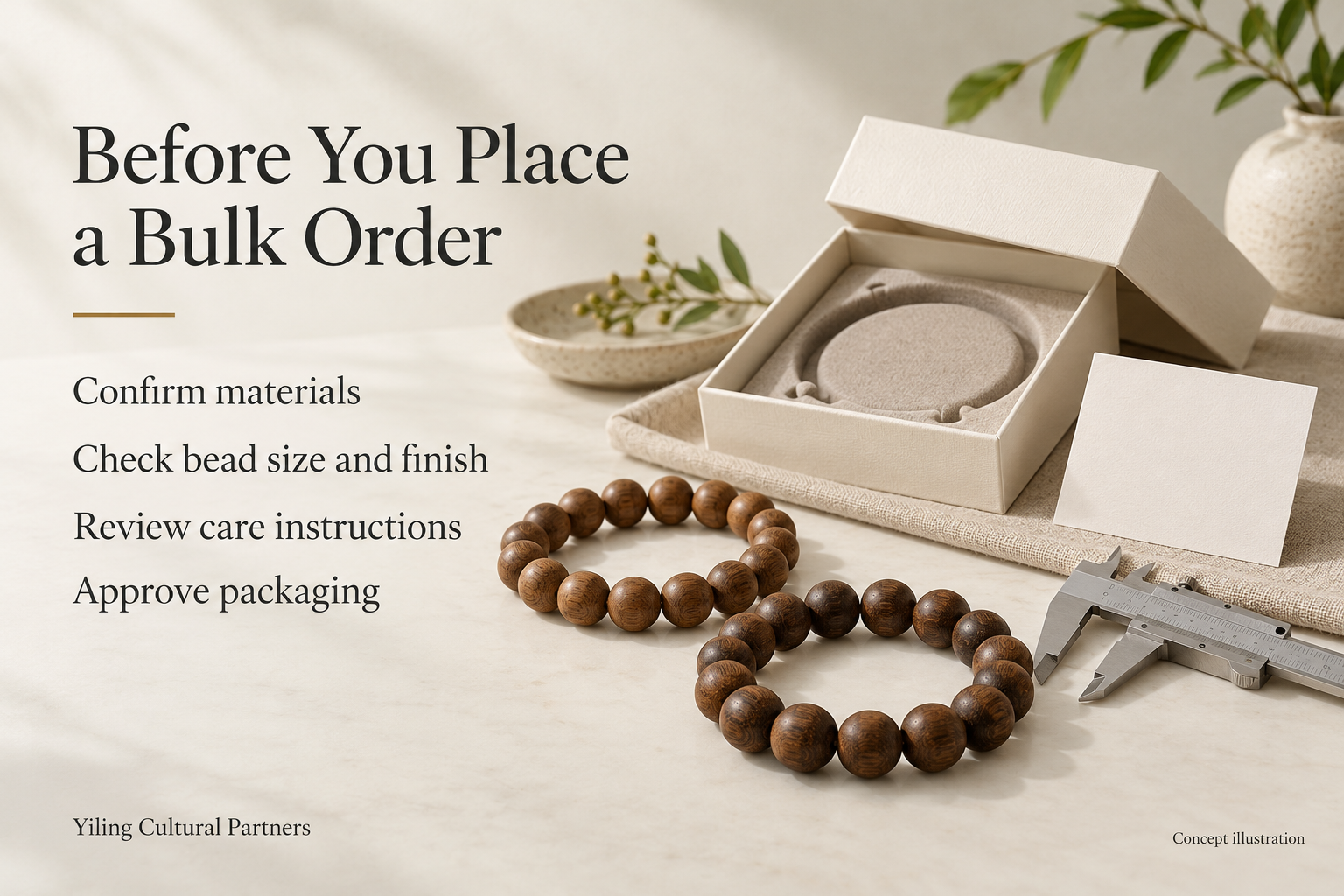
- Approve specifications, care wording, and packaging before a bulk order.
What does “incense bead bracelet” mean?
This guide focuses on formed blended-incense beads: beads made from a mixture rather than cut from a single piece of wood. Hexiang refers to blending incense materials. A binder is an ingredient that helps hold the mixture together. These terms describe construction, not a universal recipe or quality grade.
Verifiable craft evidence: a Zhifu District government description of traditional hexiang bead-making documents aromatic materials, binding auxiliaries, forming, and finishing. It describes a particular tradition, not every commercial bracelet or Yiling’s production process.
Cultural interpretation: a bracelet may carry meanings associated with fragrance appreciation, gifting, or personal reflection. Such meanings do not demonstrate therapeutic or supernatural effects. Commercial recommendation: explain the actual material first, then provide a separate cultural story. The Spiritual Product Guide gives context for responsible product presentation.
What materials should buyers ask about?
Request a material declaration for the specific product. It should distinguish the aromatic blend, binding ingredients, any added fragrance, colorants, surface treatments, cord, and decorative components. An ingredient highlighted in the product name does not establish its proportion or prove the entire bead consists of that ingredient.
A supplier may protect recipe ratios, but buyers still need sufficient composition and safety information to describe and assess the finished item. If exact percentages are confidential, discuss appropriate disclosure under a confidentiality agreement. Do not fill gaps with assumptions such as “pure sandalwood,” “chemical-free,” or “no additives.”
Ask whether scent comes from the bead mixture, a later fragrance treatment, or both. A strong aroma is not an authentication test, and a brown appearance does not establish a material’s identity. Sample inspection should support, rather than replace, supplier documentation.
How is an incense bead bracelet made?
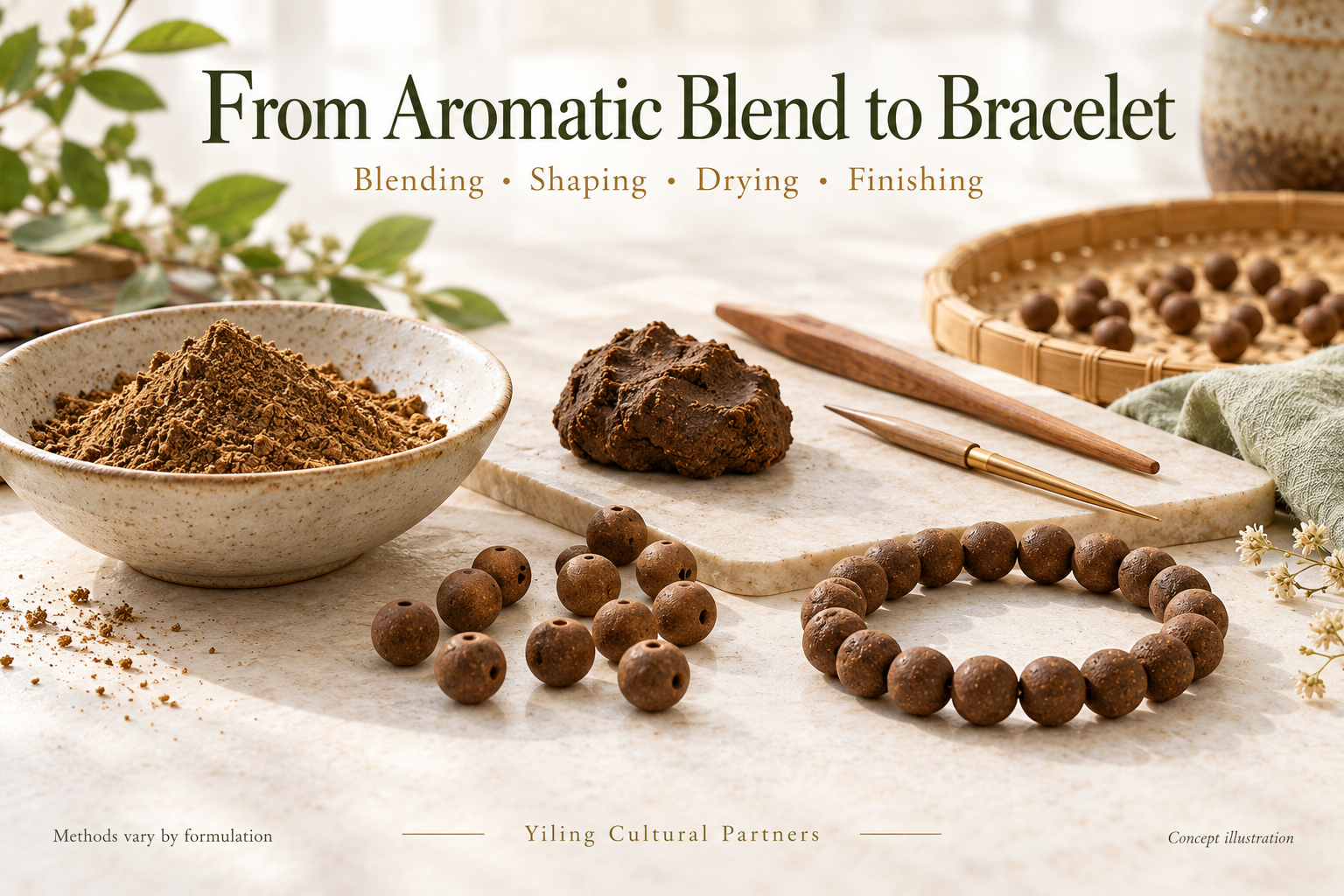
The following summarizes a general formed-bead route. A Liwan District cultural workshop account describes grinding aromatics, proportioning ingredients, adding water, kneading, and shaping beads. The Zhifu account documents additional preparation and finishing steps. Recipes and production methods differ.
- Prepare the materials. Select and process ingredients according to the intended blend.
- Grind and blend. Prepare powders and combine the specified materials.
- Make a workable mixture. Add the formulation’s binding ingredients and liquid, then mix or knead.
- Form the beads. Shape by the chosen method and create stringing holes at the appropriate stage.
- Dry and finish. Use a process suited to the formulation, then smooth or finish surfaces as required.
- Assemble the bracelet. Select beads, string them, secure the closure, and check the finished item.
“Handmade” needs clarification: mixing, shaping, finishing, and assembly may involve different combinations of handwork and equipment. Ask which operations the description covers. A heritage craft reference is not evidence that a supplier or product has heritage certification.
How do incense beads differ from wood and crystal beads?
| Type | Construction | Buyer’s main check |
|---|---|---|
| Formed incense blend | Powdered materials held together as a bead | Composition, binder, fragrance additions, finish, and care |
| Solid aromatic wood | Beads cut or turned from wood | Species, sourcing, treatments, and whether fragrance is added |
| Fragrance-treated bead | A substrate carrying an added scent | Substrate identity, fragrance treatment, and replenishment instructions |
| Crystal or stone bead | Mineral material, with possible treatments | Material identity, dyeing or other treatments, and hardware |
These categories can overlap: a formed bead or wood bead may also receive added fragrance. Mixed bracelets should disclose each component. Similar color, bead size, or packaging does not make two products materially equivalent.
Which businesses might consider this product?
Spiritual retailers, cultural gift shops, bracelet brands, and distributors may consider incense beads when their audience values fragrance, tactile materials, and craft explanations. A retailer can present a small scent-led collection or pair a bracelet with a care card and gift packaging.
The business case depends on customer fit and reliable replenishment, not assumed spiritual results or guaranteed sales. Staff should be able to explain what the beads are made from and how to handle them. The wholesale guide for crystal shops and gift stores provides a broader sourcing framework.
When might another product be more suitable?
A scented accessory may be unsuitable for fragrance-sensitive audiences or fragrance-free settings. A formulation requiring protection from moisture may not suit a range advertised for swimming, showering, or intensive sport. Buyers seeking identical scent intensity across long storage periods should require supporting product data before making that promise.
A general adult accessory should not be repackaged as children’s jewelry without a separate suitability and compliance assessment. Loose beads and detachable components require consideration in the intended use.
What should a wholesale specification and sample check include?
Agree an approved reference sample and written acceptance criteria. The checks below are procurement recommendations, not a certification scheme. They help distinguish acceptable variation from defects and keep repeat orders comparable.
| Item | Specify | Check on samples |
|---|---|---|
| Material and scent | Blend description, additions, intended scent profile | Consistency with the declared product; unexpected odor |
| Dimensions | Bead diameter, count, bracelet fit, agreed tolerances | Actual measurements and fit rather than photographs alone |
| Surface and holes | Finish, acceptable variation, defect definitions | Cracks, loose powder, rough edges, obstructed holes |
| Assembly | Cord, closure, knot position, decorative components | Security, sharp edges, and fit under agreed handling |
| Packaging | Protection, labeling, care card, pack quantity | Movement, rubbing, scent transfer, and transit condition |
| Records | Product code, batch reference, material declaration, relevant reports | Documents identify the actual material and components ordered |
Record observations on receipt and after an agreed storage interval under the same conditions. Keep different scent samples apart. If assessing rubbing, moisture exposure, or packaging performance, agree the method and pass criteria with the supplier; informal checks do not establish skin safety or regulatory compliance.
What care and scent expectations should retailers communicate?
Use instructions confirmed for the actual formulation. Unless validated otherwise, avoid describing formed aromatic beads as waterproof. Ask about contact with water, sweat, perfume, cleaning products, heat, and prolonged sunlight, as well as storage and cleaning methods.
Do not promise a fixed fragrance lifespan without product-specific evidence. Request observations under stated packaging and storage conditions. Avoid recommending added oils or water to “restore” scent unless the supplier has assessed that treatment for the finished bracelet.
A product insert should explain material, fragrance expectations, handling, and cultural context separately. The guide to product meaning cards without misleading claims can support that copy.
How should a wholesale or private-label order work?
- Define the brief. State market, audience, quantity range, dimensions, scent preferences, and packaging needs.
- Review disclosures. Confirm materials, production claims, and available supporting documents.
- Evaluate samples. Check product construction, scent expectations, care wording, and packaging.
- Approve the order. Record specifications, permitted variation, change-control terms, and defect remedies.
- Check the shipment. Match product and batch references, quantities, and agreed inspection criteria.
Request notice before changes to the blend, fragrance treatment, binder, cord, or finish. Ordinary bracelet orders do not require customer birth details. If a separate personalized reading is added, establish its minimum data requirements, customer authorization, privacy controls, and deletion arrangements separately.
What affects cost and lead time?
Quotation variables include materials, bead dimensions, shaping and finishing work, drying requirements, assembly, order quantity, packaging, customization, and any agreed testing. Ask suppliers to separate sample fees, setup charges, unit costs, shipping, and applicable import costs.
Confirm whether products are stocked or made to order, when production starts, and how sample approval affects scheduling. There is no verified Yiling price, minimum quantity, or production duration stated in this guide. These require confirmation against the selected product and destination.
What safety and marketing boundaries matter?
The US FDA notes in its fragrance information for cosmetics that some people are allergic or sensitive to fragrance ingredients. That source concerns cosmetics; it does not classify or certify these bracelets. For sourcing, do not assume a natural ingredient makes a finished accessory suitable for everyone.
Assess the actual composition, skin-contact components, intended age group, and destination-market requirements with an appropriate specialist or testing provider. A generic certificate unrelated to the ordered material is insufficient. Avoid unsupported “hypoallergenic” or “safe for all skin” claims.
The US FTC’s advertising guidance calls for truthful, non-deceptive, evidence-based claims. Describe scent and craftsmanship accurately; do not promise treatment of anxiety, insomnia, or disease. A cultural blessing is an optional separate service, not a manufacturing step or a guarantee of efficacy.
These products are offered for cultural appreciation, personal reflection, and gifting. Cultural and spiritual services do not guarantee specific financial, medical, legal, relationship, or life outcomes. Products and services do not replace professional advice.
What questions should buyers ask a supplier?
- Are the beads formed from powder, cut from wood, or made from another substrate?
- What binders, fragrances, colorants, or coatings are included?
- Which production stages are performed by hand?
- What variation and defects does the approved sample represent?
- What supports your scent, care, and skin-contact statements?
- Can material changes and batches be traced?
- Which sample fees, minimums, timelines, and replacement terms apply?
- What branding and cultural-copy options can you demonstrate?
How can Yiling Cultural Partners support a sourcing project?
Yiling Cultural Partners’ spiritual product wholesale service lists incense beads, bracelets, packaging support, product meaning cards, and sample-based cooperation. Its private-label bracelet program provides a route for discussing branded collections.
Use an inquiry to confirm the actual sample, composition, dimensions, care information, branding options, and order workflow. Ask about bilingual cards if needed. Formula details, manufacturing methods, testing, available customization, sample charges, and delivery commitments must be verified for the chosen product.
What else do business buyers ask?
Is an incense bead bracelet the same as a sandalwood bracelet?
Not necessarily. A solid sandalwood bracelet uses beads made from wood, while a formed incense bead may contain a blend of powdered materials and binders. A product described as sandalwood-scented may use an added fragrance rather than solid sandalwood. Ask for construction and composition details, including treatments, before writing product copy. The name, brown color, and smell alone cannot establish species, ingredient proportions, or whether the bead is solid wood.
How long does the fragrance last?
No single duration should be assumed for the whole category. The formulation, added fragrance, finish, packaging, storage, and use conditions can affect the experience. Ask the supplier for product-specific observations and the conditions under which they were made. Compare samples consistently rather than relying on the strongest freshly opened scent. Retail wording should explain that fragrance intensity may change, without promising permanent scent or recommending unverified methods for refreshing the beads.
Can incense bead bracelets get wet?
Do not assume that they can. Formed beads, surface treatments, cords, and decorative components may respond differently to moisture. Request written care instructions for the actual product and supporting information for any water-resistance claim. Until that is confirmed, avoid marketing the bracelet for bathing, swimming, or washing. If moisture performance is important to your range, agree an appropriate assessment with the supplier before ordering rather than treating a casual sample test as proof.
Does handmade mean every bracelet will be identical?
No. Handmade describes work involved, not a promise of identical appearance or a waiver of quality requirements. Ask which stages involve handwork and agree measurable tolerances for bead size, bracelet fit, finish, and acceptable variation. Keep an approved reference sample and photographs representing the permitted range. Cracks, insecure assembly, and other agreed defects should remain subject to the supplier’s remedy terms, even when a product is marketed as artisanal or traditionally inspired.
What should buyers do before placing a bulk order?
Choose an incense bead bracelet through verified material information, representative samples, and a written specification. Understand how the selected product is made, confirm practical care requirements, and keep cultural storytelling separate from performance claims.
Share your business type, target market, quantity range, preferred bracelet dimensions, and packaging needs to discuss sample options and applicable terms.
Request a Sample