
Chinese Zodiac Signs: The 12 Animals, Meanings, and Cultural Origins
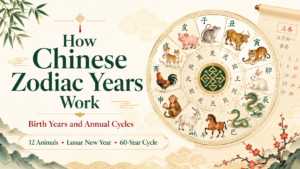
The Chinese zodiac is a repeating twelve-year cycle in which each year is associated with an animal: Rat, Ox, Tiger, Rabbit, Dragon, Snake, Horse, Goat, Monkey, Rooster, Dog, and Pig. Behind the familiar animals is an older calendrical system built around the Twelve Earthly Branches.
Chinese zodiac signs are among the most recognizable symbols of Chinese culture. They appear in New Year decorations, family conversations, birthday gifts, jade carvings, stamps, bracelets, blessing cards, annual reports, and international marketing campaigns. Yet the system is often simplified into a personality quiz based only on the birth year. Its cultural history is richer: the animals are paired with the Twelve Earthly Branches, linked with a repeating calendar cycle, and later interpreted through Five Elements, Yin–Yang, seasonal customs, art, folklore, and personal readings.
This complete beginner’s guide explains the order and conventional meaning of all twelve animals, how to identify a birth-year sign, why January and February birthdays require extra care, where the zodiac came from, how the popular Great Race story should be understood, and how zodiac reading differs from Bazi. Readers seeking a personalized report can visit the Chinese Zodiac Reading service. The shorter Zodiac Guide hub connects annual themes, products, gifts, and partner services.
What Is the Chinese Zodiac?
Beginner definition: The Chinese zodiac, commonly called shengxiao (生肖), is a twelve-part animal cycle associated with the Twelve Earthly Branches of the traditional Chinese calendar. Each year receives one animal sign, and the sequence repeats every twelve years.
The Chinese zodiac is different from the twelve-sign Western zodiac. Western zodiac signs are commonly organized around the Sun’s apparent position along the ecliptic and are assigned by month and day. Chinese zodiac animals are primarily assigned by year, although the underlying Earthly Branch system is also used for months, traditional two-hour periods, directions, and other forms of calendrical classification.
A birth-year animal is a broad cultural label, not a complete personal chart. Millions of people share the same sign. Family background, education, health, location, personal choices, historical conditions, and many other factors shape individual lives. Even within traditional Chinese metaphysics, a full Bazi chart uses the birth year, month, day, and hour rather than relying on the year animal alone.
The 12 Chinese Zodiac Animals in Order
| Order | Animal | Chinese | Earthly Branch | Recent Example Years | Conventional Symbolic Themes |
|---|---|---|---|---|---|
| 1 | Rat | 鼠 · Shǔ | 子 · Zǐ | 2008, 2020, 2032 | Resourcefulness, observation, adaptability, initiative |
| 2 | Ox | 牛 · Niú | 丑 · Chǒu | 2009, 2021, 2033 | Steadiness, labor, patience, reliability |
| 3 | Tiger | 虎 · Hǔ | 寅 · Yín | 2010, 2022, 2034 | Courage, presence, movement, protective power |
| 4 | Rabbit | 兔 · Tù | 卯 · Mǎo | 2011, 2023, 2035 | Gentleness, alertness, diplomacy, refinement |
| 5 | Dragon | 龙/龍 · Lóng | 辰 · Chén | 2012, 2024, 2036 | Vitality, authority, transformation, auspicious power |
| 6 | Snake | 蛇 · Shé | 巳 · Sì | 2013, 2025, 2037 | Strategy, intuition, observation, renewal |
| 7 | Horse | 马/馬 · Mǎ | 午 · Wǔ | 2014, 2026, 2038 | Movement, independence, energy, travel |
| 8 | Goat / Sheep / Ram | 羊 · Yáng | 未 · Wèi | 2015, 2027, 2039 | Care, artistry, community, gentleness |
| 9 | Monkey | 猴 · Hóu | 申 · Shēn | 2016, 2028, 2040 | Ingenuity, playfulness, learning, versatility |
| 10 | Rooster | 鸡/雞 · Jī | 酉 · Yǒu | 2017, 2029, 2041 | Timing, presentation, directness, diligence |
| 11 | Dog | 狗 · Gǒu | 戌 · Xū | 2018, 2030, 2042 | Loyalty, vigilance, fairness, protection |
| 12 | Pig | 猪/豬 · Zhū | 亥 · Hài | 2019, 2031, 2043 | Generosity, comfort, sincerity, completion |
The meanings above are conventional modern summaries, not fixed definitions. Chinese texts, local customs, art, folklore, commercial content, and individual readers may emphasize different traits. A responsible zodiac report explains symbolism as a cultural lens rather than declaring that everyone born in one year has the same personality.
How to Find Your Chinese Zodiac Sign
For most people, the sign is found by matching the birth year with the repeating twelve-year sequence. The important exception is a birth in January or February. The zodiac year does not automatically begin on January 1.
Chinese New Year Boundary
In popular zodiac use, the animal year generally changes at Chinese New Year, which falls on a different Gregorian date each year. A person born before that date normally belongs to the previous zodiac year. For example, someone born in early January during a calendar year commonly labeled “Year of the Dragon” may still belong to the preceding Rabbit year.
Li Chun and Bazi Conventions
Some Bazi practitioners use Li Chun, the Beginning of Spring solar term, as the year boundary for technical chart calculation. This can produce a difference for births near the start of February. Always ask which method is being used. A public zodiac gift page may follow Chinese New Year, while a technical Four Pillars report may follow the practitioner’s solar-term convention.
Cultural Origins of the Chinese Zodiac
The exact origin of the animal sequence is not explained by one surviving founding text. What can be stated more carefully is that the Twelve Earthly Branches were part of an older Chinese system for marking time, and animal associations were attached to those branches by the late pre-imperial and early imperial periods.
Museum and historical sources place the association of the twelve animals with the Chinese calendar by approximately the third century BCE, with the familiar order firmly established by the first century CE or Eastern Han period. The standard sequence became Rat, Ox, Tiger, Rabbit, Dragon, Snake, Horse, Goat or Ram, Monkey, Rooster, Dog, and Pig.
The Earthly Branches are paired with the Ten Heavenly Stems. The stems carry Yin–Yang and Five Phase associations. Because compatible Yin and Yang positions combine in sequence, the stem-branch system produces a sixty-year cycle. A year can therefore be identified more precisely as something like a Wood Dragon or Fire Horse year, not only Dragon or Horse.
The animal cycle spread and developed across East and Southeast Asia. It appeared in calendars, funerary art, sculpture, manuscripts, religious imagery, household objects, paintings, jewelry, festivals, and popular literature. Regional cultures adapted the animals and their meanings rather than preserving one identical version everywhere.
Did the Great Race Create the Zodiac Order?
The Great Race is the best-known modern folktale explaining why the animals appear in their present order. In common versions, the Jade Emperor or another divine figure announces a race across a river. The Rat uses intelligence and timing to arrive first, the hardworking Ox comes second, and the remaining animals follow according to events that explain their positions.
The story is culturally valuable because it makes the order memorable and gives each animal a narrative personality. However, it should not be presented as a verified historical account of how the zodiac began. Versions differ in the identity of the organizer, the route, the Cat’s role, the animals’ behavior, and the moral lesson. The story belongs to the evolving folklore surrounding the established zodiac system.
A strong educational article therefore separates two questions: historical evidence helps date the animal-calendar association, while folklore explains how later communities taught, remembered, and interpreted the sequence.
The Meanings of the 12 Chinese Zodiac Signs
Rat
The Rat is conventionally associated with quick observation, adaptability, resource management, and social awareness. Its first position is often explained through the Great Race story, where intelligence and timing overcome physical size. In cultural interpretation, the Rat can represent initiative and the ability to find opportunity in limited conditions.
Less flattering stereotypes describe calculation or nervousness. These should be presented as possible symbolic contrasts, not judgments about every Rat-year person.
Ox
The Ox is linked with agriculture, endurance, dependability, patience, and steady work. In an agrarian society, cattle represented essential labor and material support. Modern readings may use the Ox to discuss consistency, responsibility, and preference for proven processes.
The symbolic shadow can be stubbornness or excessive caution. Reliability should not be confused with a lack of imagination.
Tiger
The Tiger is a major symbol of power, courage, military authority, and protection in Chinese art and folklore. Tiger images have historically appeared on ritual objects, protective designs, children’s clothing, and military symbols. Zodiac descriptions often emphasize confidence, movement, and willingness to confront difficulty.
The same energy may be interpreted as impulsiveness or intensity when not regulated. A Tiger sign does not prove aggression.
Rabbit
The Rabbit is associated with alertness, grace, diplomacy, sensitivity, and refined social behavior. Chinese visual culture also connects the rabbit with lunar imagery through the Moon Rabbit tradition. Zodiac content may emphasize gentle strength, careful timing, and avoidance of unnecessary conflict.
Descriptions of caution should not be turned into claims that Rabbit-year people are weak or fearful.
Dragon
The Dragon is the only clearly mythic creature in the standard Chinese cycle. Chinese dragons are associated with rain, water, vitality, imperial symbolism, transformation, and auspicious power. They differ substantially from the destructive dragons common in some European traditions.
Dragon-year personality summaries often use confidence, ambition, charisma, or vision. These are cultural associations, not guarantees of leadership or success.
Snake
The Snake is often linked with observation, strategy, intuition, subtle movement, and renewal through shedding skin. It can carry both respected and ambivalent meanings in folklore. Modern zodiac interpretations commonly highlight patience, privacy, careful analysis, and an ability to act at the right moment.
It is misleading to equate the Snake automatically with dishonesty or danger.
Horse
The Horse symbolizes movement, travel, speed, independence, communication, and public energy. Horses were historically important for transport, warfare, trade, and status. Zodiac readings may discuss enthusiasm, mobility, direct action, and dislike of restriction.
The contrasting theme can be restlessness or difficulty sustaining attention. It should not be used to predict unstable relationships or careers.
Goat, Sheep, or Ram
The Chinese word yang can refer broadly to caprine or ovine animals, which is why English pages use Goat, Sheep, or Ram. The sign is associated with care, beauty, artistic sensibility, community, gentleness, and the wish for harmonious surroundings.
Conventional negative descriptions such as indecision or dependency should be handled carefully and never presented as fixed character defects.
Monkey
The Monkey represents ingenuity, experimentation, learning, humor, agility, and unconventional problem-solving. Monkey figures also have a rich life in Chinese literature and religious storytelling, most famously through the Monkey King, although that literary character is not the historical source of the zodiac sign.
Playfulness may become distraction or opportunism in a contrast reading, but no sign determines ethical behavior.
Rooster
The Rooster is associated with dawn, timing, vigilance, announcement, presentation, and diligence. Its regular crowing makes it a natural symbol of schedules and visible readiness. Modern readings often emphasize organization, direct speech, appearance, and attention to standards.
Directness can be interpreted as criticism when poorly expressed, but the sign does not determine communication skill.
Dog
The Dog commonly symbolizes loyalty, protection, vigilance, fairness, and devotion to family or community. In zodiac descriptions, it may support discussion of trust, ethical concern, and willingness to defend others.
The contrasting themes include worry, suspicion, or overprotectiveness. These should be treated as reflective possibilities rather than personality facts.
Pig
The Pig is associated with abundance, nourishment, generosity, sincerity, enjoyment, and the completion of the twelve-sign sequence. In household and agricultural culture, pigs could represent material well-being and food security.
Popular descriptions sometimes confuse enjoyment with laziness or excess. A respectful reading recognizes both the sign’s positive cultural associations and the limits of stereotypes.
Chinese Zodiac Signs and the Five Elements
The twelve animal cycle operates together with the Ten Heavenly Stems. Each stem is associated with Wood, Fire, Earth, Metal, or Water and with Yin or Yang. This creates more specific year labels such as Wood Snake, Fire Horse, Earth Goat, Metal Monkey, or Water Rooster.
Because the stem and branch cycles repeat at different lengths, the complete combination returns every sixty years. This means two people born twelve years apart share an animal but usually not the same stem element. A 2024 Wood Dragon year, for example, is not identical in traditional symbolism to another Dragon year with a different element.
Element-animal combinations are useful for annual content, gift cards, and introductory readings. They still do not equal a complete personal Five Elements analysis. A full interpretation may require the birth month, day, hour, seasonal structure, and Day Master. Explore Five Elements Reading or read The Five Elements in Chinese Culture for the broader framework.
Chinese Zodiac Reading vs. Bazi Reading
| Feature | Chinese Zodiac Reading | Bazi Reading |
|---|---|---|
| Main data | Primarily birth year and animal sign; may add year element and annual theme | Birth year, month, day, hour, and usually birthplace for time verification |
| Complexity | Accessible and suitable for beginners | More technical and individualized |
| Best use | New Year content, birthday gifts, introductory symbolism, zodiac products | Detailed cultural interpretation, Day Master, Five Elements, timing and life themes |
| Limit | Millions of people share the same sign | Still interpretive and non-deterministic; accuracy depends on birth data and method |
The year animal is included inside a Bazi chart as the year branch, but it is only one part of eight visible characters. People wanting a detailed birth-chart explanation should visit the Bazi Reading page and the beginner article What Is Bazi Reading?.
Chinese Zodiac Compatibility and Relationships
Zodiac compatibility charts are popular because they provide an easy conversation starter. Traditional systems may group signs through combinations, oppositions, trines, or branch relationships. Popular lists then describe some animal pairs as harmonious and others as challenging.
These pairings should not be used to approve or reject a relationship. Two people with supposedly compatible year signs can have serious communication problems, while people with opposing signs can build a stable partnership. A birth-year comparison omits personality development, family culture, values, circumstances, and the other pillars used in Bazi.
Responsible compatibility content uses prompts such as communication style, pace, boundaries, shared expectations, and conflict management. It does not claim that a sign proves infidelity, guarantees marriage, or shows that another person must return. For a structured cultural report, see Love Compatibility Reading.
Regional Variations Across Asia
The twelve-animal cycle spread beyond China and developed local forms. Translation alone creates variation: the eighth Chinese sign may be called Goat, Sheep, or Ram in English, and the Rooster may be called Cock or Chicken. The final animal may be translated as Pig or Boar.
Vietnam commonly uses the Water Buffalo in place of the Ox and the Cat in place of the Rabbit. Other East and Southeast Asian traditions may adjust names, artistic forms, calendars, and folklore while retaining a related twelve-year structure. It is therefore better to say “Chinese zodiac” when discussing the Chinese sequence and “East Asian” or “lunar zodiac traditions” when comparing multiple cultures.
“Lunar New Year” is also a broader term than “Chinese New Year.” Different communities celebrate with distinct histories, foods, names, and customs. A global business should avoid treating every Asian New Year celebration as a single interchangeable tradition.
The Zodiac in Chinese New Year, Art, and Daily Culture
New Year Decorations
The incoming animal appears on red envelopes, paper cuts, lanterns, calendars, advertising, public installations, clothing, and family gifts.
Art and Collecting
Sets of zodiac animals have been made in jade, ceramic, metal, painting, textiles, tomb figures, seals, coins, and decorative arts.
Birth and Family Conversation
Families may discuss a child’s animal sign, element year, generation, naming ideas, or symbolic gifts. Beliefs vary widely among households.
Annual Reflection
A zodiac year may be used for seasonal planning, New Year messages, Tai Sui-related cultural services, and reflective reminders without claiming fixed fortune.
Festivals and Education
Museums, schools, libraries, and cultural organizations use the twelve animals to introduce calendars, art, language, folklore, and regional traditions.
Modern Branding
Zodiac collections support jewelry, fashion, beauty, food packaging, home décor, digital reports, and limited-edition campaigns.
Chinese Zodiac Gifts, Bracelets, and Blessing Cards
Zodiac symbolism works especially well for birthdays, Lunar New Year, baby gifts, anniversaries, milestone years, store campaigns, and cultural gift sets. A meaningful product does not need to make a supernatural guarantee. Its value can come from design, craftsmanship, personalization, cultural explanation, and the intention of the giver.
Useful Zodiac Gift Components
- An animal symbol or engraved branch character
- A short explanation of conventional qualities
- The year’s Heavenly Stem element when relevant
- A personalized name or birthday card
- A bracelet, amulet, crystal, incense bead, or decorative object
- A blessing card using non-guarantee wording
- An optional annual reflection or zodiac reading summary
Browse Spiritual Bracelets, Blessed Gift Sets, Amulets, and Blessing Cards for related pathways.
Request a Personal Chinese Zodiac Reading
Share your birth date, birthplace if relevant, preferred language, reading theme, delivery format, and whether the request is for personal reflection, an annual theme, a birthday gift, bracelet matching, or a New Year package. Scope, timing, privacy, quote, and payment instructions are confirmed privately.
View Chinese Zodiac Reading Submit a Private InquiryChinese Zodiac Content for B2B and White-Label Programs
Zodiac content is highly adaptable for spiritual shops, bracelet brands, crystal sellers, gift companies, cultural organizations, live sellers, and private communities. It is easy for international customers to understand and can be organized into twelve evergreen product themes plus one annual campaign.
Possible Business Deliverables
- White-label Chinese zodiac reports
- Twelve animal product descriptions and landing pages
- Zodiac bracelet, amulet, and gift collections
- New Year email, social, and private-community campaigns
- Animal meaning cards and packaging inserts
- Annual element-animal summaries
- Live-selling scripts and customer-service replies
- Personalized PDF, image-card, or message delivery
- Optional product blessing or festival ritual connections
A partner workflow should define customer data, sign-calculation method, language, report depth, branding, turnaround, revision rules, product claims, and privacy. Review White-Label Destiny Reading Reports, Private Label Bracelet Program, and the Partner Inquiry page.
For SEO, avoid publishing twelve pages that differ only by the animal name. Each sign page should have distinct cultural art references, birth-year table, element combinations, gift ideas, FAQs, product links, and responsible interpretations. This long guide should act as the pillar page linking to the future twelve-sign cluster.
Common Chinese Zodiac Misunderstandings
- The sign always changes on January 1: it usually changes at Chinese New Year in popular use, while some Bazi methods use Li Chun.
- The Great Race is the documented historical origin: it is a popular explanatory folktale, not the sole historical source.
- Everyone born in one year has the same personality: the animal is a broad symbolic category.
- Zodiac and Bazi are identical: Bazi uses four pillars and much more birth information.
- Compatibility charts determine marriage: they are cultural prompts, not relationship verdicts.
- A person’s zodiac year must be disastrous: annual traditions vary and should not be used for fear-based selling.
- Goat, Sheep, and Ram are three separate Chinese signs: they are translation choices for the same Chinese zodiac position.
- Every Asian culture uses exactly the same animals: regional traditions include meaningful variations.
- A zodiac product guarantees protection: products provide symbolism, design, and gift meaning, not guaranteed outcomes.
- The year element is the person’s complete element profile: it is only one layer and does not replace a full Five Elements or Bazi reading.
Frequently Asked Questions About Chinese Zodiac Signs
What are the 12 Chinese zodiac animals in order?
Rat, Ox, Tiger, Rabbit, Dragon, Snake, Horse, Goat or Sheep, Monkey, Rooster, Dog, and Pig.
What is my Chinese zodiac sign?
Match your birth year to the twelve-year cycle. For January or February birthdays, check the exact Chinese New Year date and the calculation method used by the reader.
Does the zodiac year start on January 1?
No. Popular zodiac years generally change at Chinese New Year. Some Bazi methods use Li Chun, the Beginning of Spring solar term, for technical year-pillar calculation.
How old is the Chinese zodiac?
The Earthly Branch system is ancient. Evidence indicates that the calendar-animal association developed by roughly the third century BCE and the standard sequence was established by the first century CE.
Is the Great Race the true origin of the zodiac?
The Great Race is a popular folktale that explains and teaches the animal order. It should not be treated as a verified historical account of the system’s creation.
Why is the Rat first?
Folklore often explains that the Rat used intelligence and timing to win the Great Race. Historically, the Rat is paired with Zi, the first Earthly Branch.
Why are Goat, Sheep, and Ram all used?
The Chinese term yang can refer broadly to sheep- or goat-like animals. English translations therefore vary according to region, art, and editorial preference.
Why is the Dragon different from Western dragons?
Chinese dragons are commonly associated with water, rain, vitality, authority, and auspicious power. They are not defined primarily as fire-breathing monsters.
Is Chinese zodiac the same as Bazi?
No. Zodiac reading focuses mainly on the year animal and related symbolism. Bazi uses year, month, day, and hour pillars for a more detailed traditional interpretation.
What do the Five Elements add to the zodiac?
The Heavenly Stem gives a year a Wood, Fire, Earth, Metal, or Water association and a Yin or Yang polarity. The full stem-branch combination repeats every sixty years.
Are Chinese zodiac compatibility charts accurate?
They are traditional symbolic frameworks, not scientifically validated relationship tests. They should support reflection, not decide whether a relationship will succeed.
Why does Vietnam have a Cat instead of a Rabbit?
The Vietnamese zodiac developed regional variations and commonly uses the Cat in the fourth position and the Water Buffalo in the second. Explanations for the historical change vary.
Can I wear my zodiac animal?
Yes. Zodiac jewelry, bracelets, amulets, and cards can express cultural identity, personal symbolism, or gift meaning. They do not guarantee protection or luck.
What is a zodiac year or benmingnian?
It is a year sharing the same zodiac animal as a person’s birth year, occurring every twelve years. Customs and beliefs around it vary, and it should not be marketed as automatically dangerous.
Can businesses resell zodiac reports and products?
Yes. White-label reports, zodiac cards, gift sets, bracelets, campaign content, and product descriptions can be created when customer data, cultural wording, branding, and non-guarantee claims are managed responsibly.
Related Zodiac, Reading, and Product Pages
Build a Personal or White-Label Zodiac Plan
Tell the team whether you need a personal zodiac reading, annual reflection, birthday gift, bracelet or amulet recommendation, New Year campaign, twelve-sign product collection, or white-label report program. Service scope, required information, delivery format, timing, pricing, privacy, and compliant wording will be confirmed privately.
Submit a Private Inquiry Request a Partner Plan